
Alpinion Women’s Health Ultrasound in 2026: X-CUBE 90, X-CUBE 70 and X-CUBE i9
Women’s health practices evaluating ultrasound technology often face a familiar challenge.
They want strong imaging performance, modern workflow tools and clinical capabilities that can support OB/GYN or fertility examinations—but they also have to make responsible decisions about equipment cost, room utilization, mobility, service and long-term ownership.
That makes Alpinion an important manufacturer to include in a 2026 ultrasound evaluation.
Preferred Medical’s current Alpinion portfolio spans multiple performance and mobility levels, including the X-CUBE 90, X-CUBE 70, X-CUBE 60, X-CUBE 50, X-CUBE i9 and X-CUBE i8.
For women’s health buyers, three platforms create a useful starting framework:
X-CUBE 90 with Elite, X-CUBE 70 with Elite and X-CUBE i9.
These systems should not be viewed simply as a good-better-best ladder. They address different clinical and operational environments.
The right question is:
Which Alpinion platform gives our practice the imaging capability, workflow, mobility and ownership profile we actually need?
Why Alpinion Belongs in the Women’s Health Ultrasound Conversation
Alpinion has built its current X-CUBE family around a combination of imaging architecture, transducer technology, automation and workflow design.
The company’s higher-level cart-based platforms use its X+ Architecture, including X+ Crystal Signature transducer technology and its beamforming and data-processing technologies.
For a buyer, however, architecture is only meaningful when it improves the examinations the practice performs.
In women’s health, that may mean supporting obstetric measurements efficiently, obtaining useful endovaginal images, performing follicular assessment, improving fetal visualization or allowing sonographers to move through a busy schedule with fewer repetitive steps.
Alpinion’s current intelligent workflow functions include tools such as X+ Auto Biometry, X+ Auto Follicle and Auto NT.
Those features make the X-CUBE portfolio especially relevant to OB/GYN and fertility organizations evaluating how workflow automation fits into their clinical operation.
X-CUBE 90 with Elite: The Higher-Level Cart-Based Platform
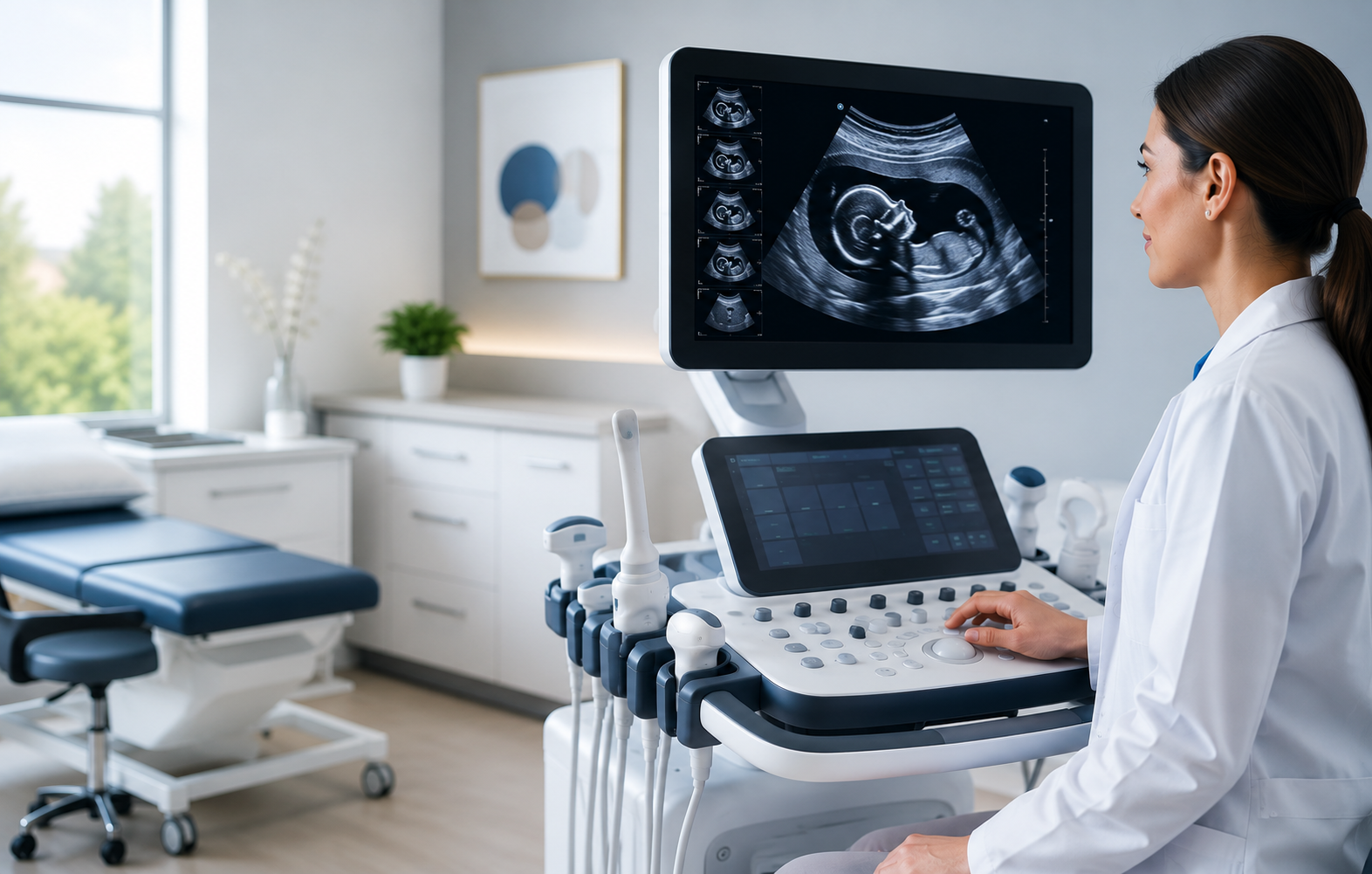
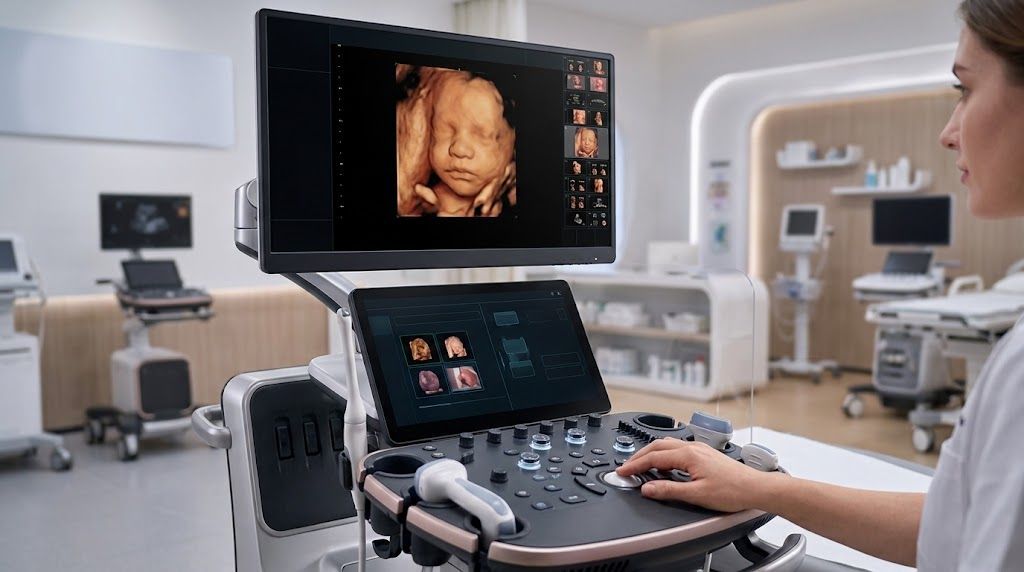
The X-CUBE 90 with Elite sits at the upper end of Alpinion’s current diagnostic ultrasound portfolio. It is built on X+ Architecture and combines advanced imaging technology with a larger, ergonomically adjustable cart-based platform.
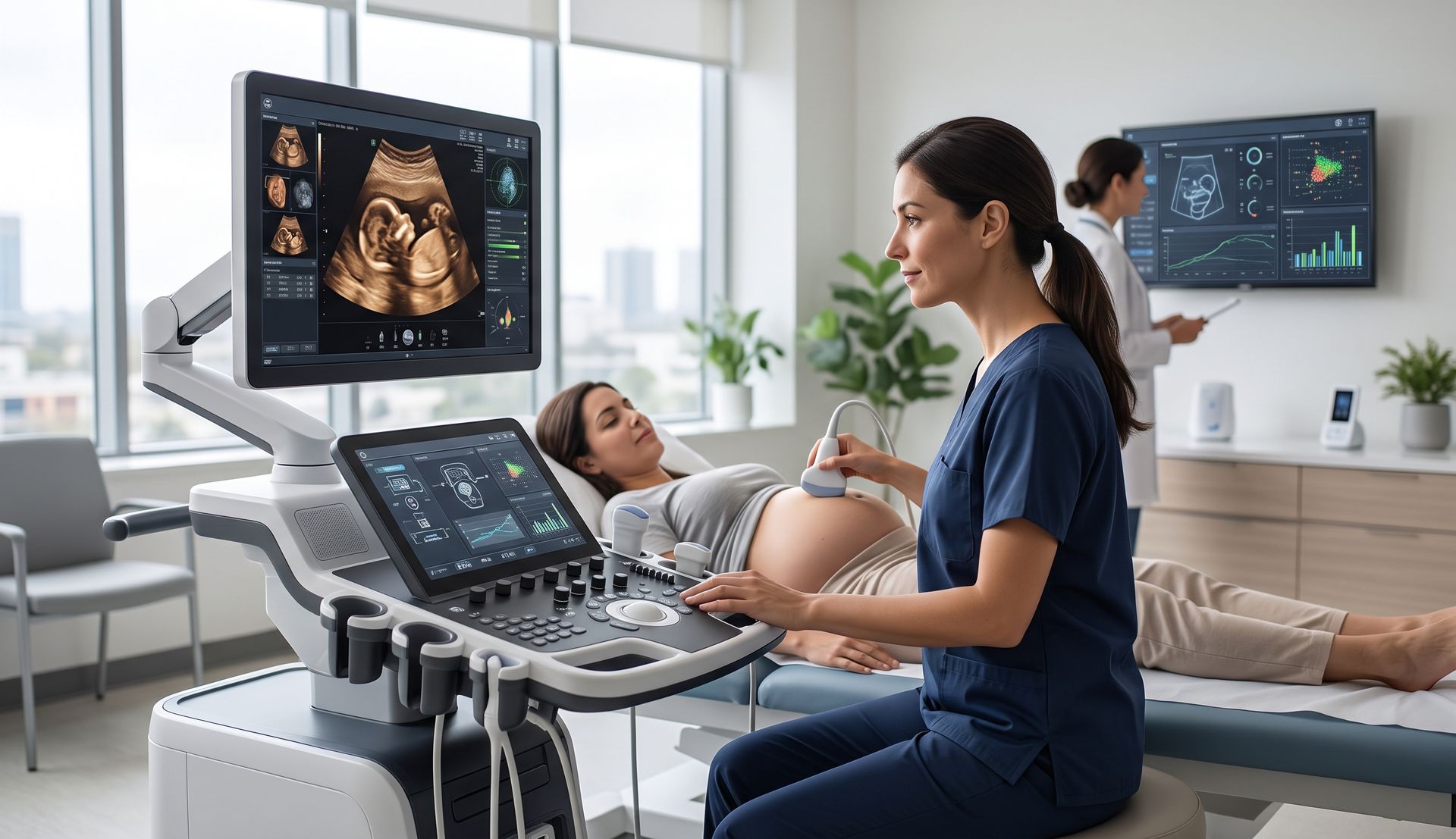
For women’s health organizations, the X-CUBE 90 may be particularly relevant when the clinical environment demands a full-featured system that will remain in a dedicated ultrasound room or high-volume department.
Potential settings include:
- Established OB/GYN practices
- Fertility programs
- Women’s imaging centers
- Hospital departments
- Multispecialty imaging facilities
- Higher-volume ultrasound environments
One important part of the X-CUBE 90 conversation is transducer selection.
Alpinion lists convex and specialty transducers for obstetric and gynecologic imaging, along with high-frequency linear transducers applicable to breast and other superficial imaging.
For a women’s imaging center that combines pelvic, obstetric and breast ultrasound, that broader transducer capability may influence the system evaluation.
Workflow automation for OB/GYN
Alpinion’s X+ Auto Biometry technology is designed to assist with common fetal measurements.
Depending on configuration, the system can automatically identify structures used for measurements such as head circumference, biparietal diameter, femur length and abdominal circumference.
The clinical user remains responsible for evaluating the examination, but automation can potentially reduce repetitive measurement steps and improve workflow consistency.
For high-volume obstetric environments, that can be important.
A few seconds saved on an isolated task may seem minor. Repeated across a full day of scanning, however, workflow efficiency can influence room utilization and sonographer experience.
X-CUBE 70 with Elite: Balancing Capability and Practicality
The X-CUBE 70 with Elite provides another cart-based option using Alpinion’s X+ Architecture. Alpinion describes the platform around high resolution, sensitivity, wideband transducers and smart workflow.
For many private practices, that combination may make the X-CUBE 70 an especially useful comparison point. A practice may want advanced OB/GYN functionality without necessarily requiring the highest-level configuration available in the portfolio.
That makes the X-CUBE 70 relevant for:
- Private OB/GYN practices
- Fertility clinics
- Growing women’s health groups
- Outpatient imaging centers
- Satellite locations
- Practices seeking a full cart-based platform with a disciplined capital strategy
The difference between choosing an X-CUBE 70 and X-CUBE 90 should not be determined by model numbering alone.
Compare the exact configuration. That includes the transducers, installed software, advanced applications, workflow tools, warranty and expected ownership period.
In some environments, an appropriately configured X-CUBE 70 may support the complete examination mix without requiring the additional capabilities of a higher-level platform.
In another organization, anticipated clinical growth may justify starting with the X-CUBE 90.
The purchasing decision should be based on the program—not a specification sheet.
Fertility Workflow: Why Auto Follicle Matters
Fertility imaging creates a distinctive ultrasound workflow. Follicular monitoring may involve identifying and measuring multiple follicles repeatedly across treatment cycles. That can make measurement efficiency particularly important.
Alpinion’s X+ Auto Follicle technology is designed to identify and measure multiple follicles automatically. For reproductive-medicine teams, this type of automation deserves hands-on evaluation.
The important question is not whether the feature exists. It is whether it fits the practice’s workflow, produces measurements clinicians are comfortable reviewing, integrates efficiently into documentation and reduces unnecessary manual effort.
During a demonstration, fertility teams should test representative ovarian examinations rather than relying on prerecorded examples.
Evaluate:
- Endovaginal image quality
- Follicle identification
- Measurement workflow
- Editing and confirmation
- Reporting
- Comparison with prior studies
- User interface
- Transducer ergonomics
A fertility program may ultimately prioritize these workflow considerations more heavily than advanced fetal visualization features that are central to a general OB practice.
Auto NT and Obstetric Workflow
Alpinion also offers Auto NT functionality to assist with nuchal translucency measurement workflow. The technology allows the user to define the relevant area and supports automatic measurement.
For obstetric programs performing first-trimester imaging, automation may contribute to a more streamlined workflow when used appropriately within the organization’s clinical protocols and professional requirements.
Again, the key purchasing principle is to evaluate the complete workflow. An ultrasound feature should not be selected because it appears impressive on a marketing sheet. It should solve a real clinical or operational problem for the practice.
X-CUBE i9: Mobility Changes the Buying Decision
The X-CUBE i9 represents a different type of ultrasound decision. Rather than competing solely on the capabilities of a traditional cart-based system, the X-CUBE i9 emphasizes mobility and flexibility.
Alpinion describes the system as a versatile solution offering mobility, intuitive workflow and intelligent clinical applications. Its configuration can include dual active transducer connections and dual batteries, supporting movement between examination environments.
That makes it relevant for:
- Satellite OB/GYN offices
- Multisite practices
- Mobile imaging programs
- Space-constrained examination rooms
- Overflow scanning
- Procedure environments
- Organizations needing a secondary ultrasound system
Portability should not automatically be interpreted as a clinical compromise. The right question is whether the compact platform supports the specific examinations the practice intends to perform.
A portable or compact ultrasound machine can be extremely valuable when mobility is essential, but it should still be evaluated for the required transducers, imaging applications, connectivity, battery expectations and everyday ergonomics.
Cart-Based vs. Compact: Start With the Workflow
A simple framework can help.
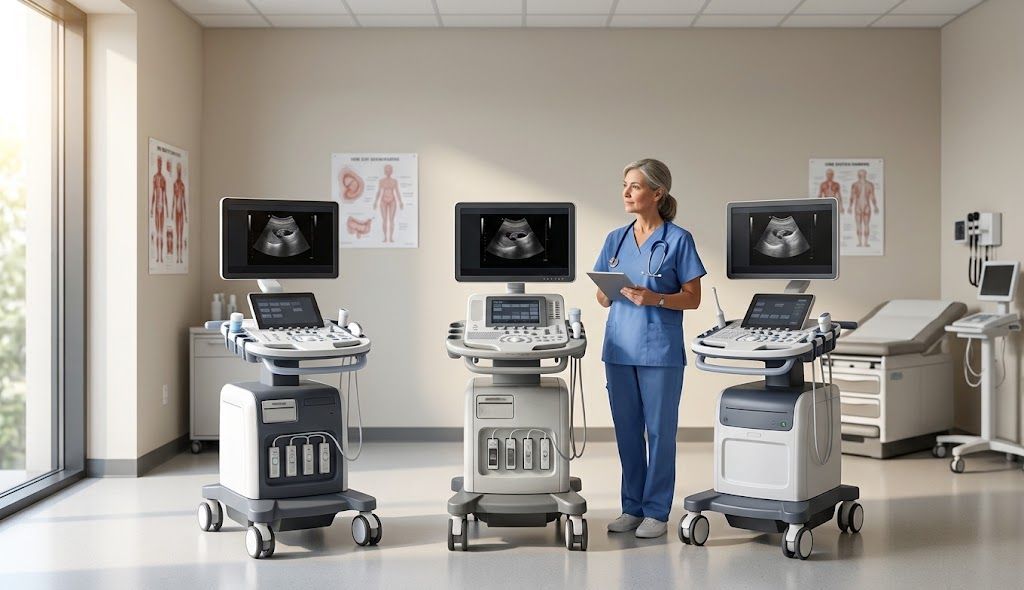
Choose a cart-based system when the ultrasound room is relatively fixed, examination volume is high, maximum screen and console ergonomics matter and the system will support a broad set of scheduled studies.
Consider a compact platform when mobility, room sharing, satellite operation or transportation between locations is a meaningful part of the workflow.
Some organizations need both.
A multisite OB/GYN group may operate an X-CUBE 90 or X-CUBE 70 at its primary imaging location while using an X-CUBE i9 for satellite clinics.
That type of fleet strategy can be more useful than trying to force one model to meet every operational need.
Compare the Complete Clinical Configuration
One of the most common purchasing mistakes is comparing ultrasound machines by console price.
For women’s health, the complete configuration may include:
- Endocavitary transducer
- Curved-array transducer
- Volume transducer
- High-frequency linear transducer
- Obstetric measurement package
- 3D/4D functionality
- Fertility applications
- Doppler capabilities
- DICOM connectivity
- Reporting interfaces
- Accessories
- Applications training
- Warranty
- Service coverage
If two proposals do not include the same clinical requirements, they are not directly comparable. This is particularly important when evaluating new, demonstration and pre-owned equipment. A lower acquisition price may be less attractive after adding missing probes, software licenses or connectivity options.
Look Beyond the Purchase Price
The system has to remain productive after installation.
That means the purchasing conversation should include:
- Expected system life
- Warranty terms
- Probe coverage
- Preventive maintenance
- Service availability
- Software support
- Training
- Installation
- Connectivity
- Financing
- Replacement strategy
A practice that evaluates only the acquisition price may miss costs that become more important during years two through five.
The strongest equipment plan considers lifecycle value from the beginning.
Which Alpinion X-CUBE System Fits Your Practice?
For a high-volume women’s imaging or OB/GYN environment seeking a higher-level cart-based system, the X-CUBE 90 with Elite may provide the appropriate starting point.
For private practices and outpatient environments looking for a capable cart-based platform with a different performance and investment profile, the X-CUBE 70 with Elite deserves close evaluation.
For practices where mobility is part of the clinical model, the X-CUBE i9 introduces a different set of advantages.
None is automatically the right answer.
The decision depends on the examinations you perform, the transducers you require, your scanning volume, room design, staffing, mobility requirements, service expectations and long-term growth plans.
Build the Alpinion Configuration Around the Clinical Need
Preferred Medical offers multiple Alpinion X-CUBE systems for U.S. healthcare providers and works with OB/GYN practices, fertility centers, imaging facilities and women’s health organizations on ultrasound equipment planning.
A productive evaluation should begin with the clinical work rather than the machine:
- Define the examination mix.
- Identify the required probes.
- Determine which automation and workflow tools will actually be used.
- Decide whether the system will remain in one room or move between locations.
- Then compare the configuration, support structure and acquisition strategy that fit those requirements.
Considering Alpinion for your women’s health program?
Talk with Preferred Medical about comparing the X-CUBE 90, X-CUBE 70, X-CUBE i9 and other appropriate Alpinion configurations based on your imaging requirements, workflow, mobility needs, budget and plans for growth.

Should You Buy, Finance, or Lease an OB/GYN Ultrasound Machine in 2026? A Practice Acquisition Guide

How Many Scans Does It Take to Pay for an OB/GYN Ultrasound Machine? A 2026 ROI and Break-Even Guide