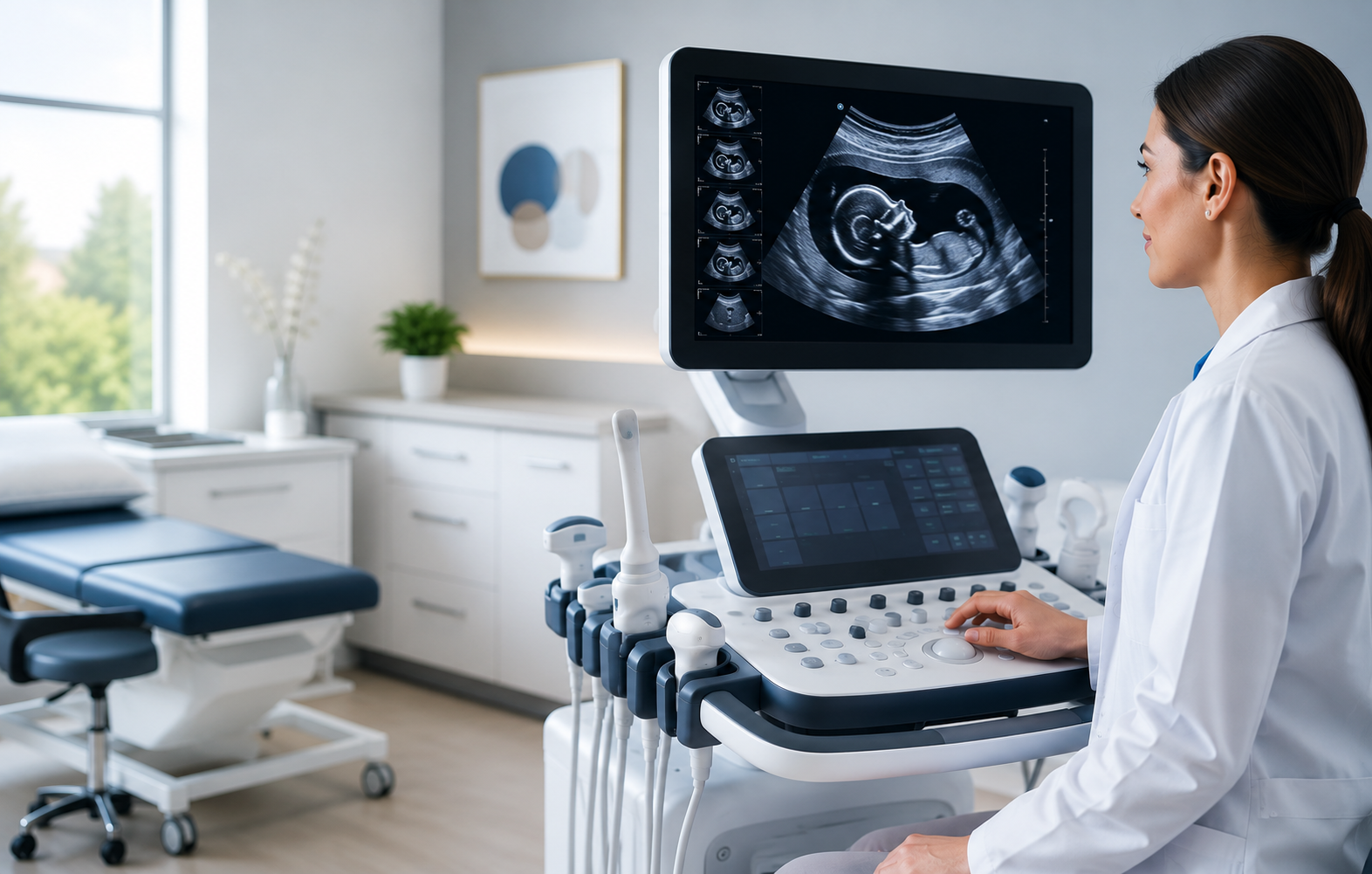

Mindray Women’s Health Ultrasound in 2026: Imagyn I9, Resona I9T and Consona N9
Women’s health ultrasound purchasing decisions have become increasingly specialized.
An OB/GYN practice may need fast, repeatable fetal measurements and efficient 3D/4D workflow. A fertility center may place greater emphasis on endovaginal imaging and follicular assessment. A maternal-fetal medicine program may require more advanced imaging capability, while a multispecialty outpatient center may need one ultrasound platform to support women’s imaging alongside breast, vascular, abdominal or other examinations.
That is why choosing a Mindray ultrasound system should begin with the clinical environment rather than simply comparing model names.
In the United States, Mindray offers ultrasound technology that can serve several levels of women’s health imaging. Within Preferred Medical’s current portfolio, the conversation includes the Imagyn I9, Resona I9T and Consona N9, along with compact systems for organizations that require additional mobility.
Each platform approaches the problem differently.
The important question for a women’s health organization is therefore not, “Which Mindray machine has the most features?”
It is:
Which Mindray ultrasound platform best matches our examination mix, workflow, clinicians, growth strategy and budget?
Mindray’s Approach to Women’s Health Ultrasound
Mindray North America positions women’s health ultrasound around obstetrics, maternal-fetal medicine, gynecologic care and breast imaging.
Across its current technology, several themes recur: automated workflow, ergonomic system design, consistent imaging, advanced visualization and tools intended to reduce repetitive manual steps.
That matters because ultrasound productivity is not determined by image quality alone.
A system also has to function effectively over a full clinic day.
Sonographers repeatedly adjust controls, change transducers, enter measurements, optimize images, save studies and move between patients. Small workflow improvements multiplied across hundreds or thousands of examinations can become operationally meaningful.
Mindray’s ZONE Sonography Technology+, or ZST+, is central to several of its higher-level platforms. Mindray describes the architecture as a channel-data-based approach designed to support image quality, tissue uniformity and ongoing software-driven development.
For buyers, however, the practical value should always be evaluated in the context of actual scanning.
Technology specifications are useful, but a clinical demonstration using representative examinations remains one of the best ways to determine whether a platform fits the people who will use it.
Imagyn I9: Purpose-Built for Women’s Health
For organizations seeking a platform designed specifically around women’s health, the Mindray Imagyn I9 is the most natural place to begin.
Mindray North America describes the Imagyn I9 as a purpose-built women’s health ultrasound system.
That distinction matters.
A dedicated women’s health platform can be particularly appealing for OB/GYN groups, fertility programs and practices where the majority of ultrasound volume comes from obstetric and gynecologic examinations rather than a broad shared-service workload.
The Imagyn I9 combines advanced imaging with an ergonomic design intended to reduce the physical burden of scanning.
Features include an intelligent iConsole control panel, customizable E-Ink keys and a free-floating user interface. The system also incorporates a 23.8-inch monitor, battery-supported operation and a design intended to let the clinician work closer to the patient without repeatedly reaching across the examination table.
For a busy OB/GYN department, those features should not be viewed as cosmetic.
Ergonomics can influence how comfortably sonographers work throughout a high-volume schedule. Controls that are easier to position, reach and customize may support a more sustainable scanning environment.
The Imagyn I9 also incorporates automation across portions of the imaging workflow.
Depending on configuration, Mindray women’s health technologies can support tasks such as fetal image optimization, automated plane acquisition, measurements and advanced visualization.
The value proposition is straightforward: reduce repetitive steps where appropriate while allowing the clinician to remain in control of the examination.
Who should evaluate the Imagyn I9?
The Imagyn I9 deserves particular consideration for:
- Dedicated OB/GYN practices
- Women’s health centers
- Fertility and reproductive-medicine programs
- High-volume obstetric imaging environments
- Organizations prioritizing sonographer ergonomics
- Practices looking for a modern women’s-health-specific workflow
The exact configuration still matters.
Transducers, software packages, connectivity, reporting requirements and advanced applications should be defined before the organization compares proposals.
Resona I9T: When Women’s Imaging Is Part of a Broader Clinical Mission
Not every women’s imaging organization wants a dedicated OB/GYN platform.
Some hospitals, imaging centers and multispecialty practices need a system capable of supporting women’s imaging alongside other applications.
That is where the Mindray Resona I9T becomes especially relevant.
Mindray North America positions the Resona I9T for general imaging, vascular, women’s imaging and shared-service applications.
In practical terms, that makes it a different purchasing proposition from the Imagyn I9.
A breast and women’s imaging center, for example, may want strong gynecologic and obstetric capabilities but also require high-frequency imaging, vascular work or other general imaging applications.
A hospital ultrasound department may similarly prefer a versatile platform that can move between examination categories without requiring a separate system for every specialty.
The Resona I9T uses ZST+ technology and incorporates AI-enhanced workflow capabilities. Its physical design also emphasizes flexibility, with a floating control panel and adaptable user interface.
The key advantage is breadth.
Rather than asking whether the Resona I9T is “better” than the Imagyn I9, buyers should ask whether their clinical environment benefits from the additional shared-service versatility.
For a dedicated OB/GYN clinic, a women’s-health-focused platform may make more sense.
For an imaging department serving several specialties, the Resona I9T may align more naturally with the workload.
Consona N9: A Practical Path for Growing Practices
The Mindray Consona N9 provides another option for practices that want advanced imaging and automation while balancing clinical requirements with acquisition strategy.
Mindray describes the Consona N9 as supporting general imaging, women’s health and cardiovascular applications.
For OB/GYN use, its available women’s health tools include technologies such as Smart OB, Smart Planes CNS, Smart Face and follicular assessment capabilities.
These tools address familiar workflow demands.
Smart OB is designed to assist with common fetal biometric measurements.
Smart Planes CNS uses automation to identify standard fetal central nervous system planes and measurements from volume data.
Smart Face assists with visualization of the fetal face by reducing obstructing volume information.
Smart follicular tools can support reproductive-medicine workflow by assisting with follicle identification and measurement.
For a growing private practice, those capabilities can make Consona N9 particularly interesting.
The organization may not require the same level of specialized platform investment as a large tertiary women’s imaging department, but it may still want modern workflow tools and room to support multiple applications.
Matching the Platform to the Practice
The best Mindray configuration depends heavily on the clinical model.
A dedicated OB/GYN group may place the Imagyn I9 near the top of its evaluation because of its women’s-health-specific design and workflow.
A fertility center should focus heavily on endovaginal imaging, follicular assessment, reporting workflow, reproductive-medicine measurements and the transducer package.
A multispecialty imaging center may find the broader capabilities of the Resona I9T more appropriate.
A growing private practice may evaluate Consona N9 when balancing women’s health functionality, shared-service potential and overall equipment strategy.
A multisite group should add another consideration: standardization.
Using related platforms across multiple offices can potentially simplify staff training, service planning, presets, workflow and equipment management.
That does not mean every office needs identical equipment.
A flagship location may justify a higher-level system while a satellite site operates a different platform appropriate for its examination volume.
The objective is to create a coherent fleet rather than purchase each machine independently.
Do Not Compare Consoles Without Comparing Transducers
Transducers deserve their own line item in every ultrasound proposal.
For women’s health, the required package may include some combination of:
- Endocavitary imaging
- Curved-array abdominal imaging
- Volume imaging
- High-frequency linear imaging
- Breast imaging
- Specialty applications
The right console with the wrong transducer package is still the wrong configuration.
Before approving a Mindray proposal, confirm exactly which transducers are included, which examinations they support, what warranty applies and what future replacement options look like.
This is especially important when comparing new, demonstration and pre-owned systems.
Two machines with the same model name can have materially different clinical capability depending on software and probes.
Evaluate Workflow, Not Just Image Quality
A clinical demonstration should reproduce the way the practice actually works.
Have the users who perform the examinations evaluate:
- Patient setup
- Transducer changes
- B-mode optimization
- Doppler workflow
- Fetal measurements
- Gynecologic workflow
- 3D/4D functions when applicable
- Follicular assessment when applicable
- Image storage
- Reporting
- DICOM workflow
- User customization
- System positioning
- Control-panel ergonomics
A five-minute product demonstration can make almost any modern ultrasound platform look impressive.
A meaningful evaluation asks whether the system remains intuitive through the repetitive tasks that define a normal workday.
Consider the Complete Ownership Model
The equipment decision does not end when the model is selected.
Practices should also evaluate:
- Warranty
- Applications training
- Preventive maintenance
- Service response
- Software support
- Transducer coverage
- Financing or leasing
- Installation
- Connectivity
- Future upgrades
- Expected ownership period
Preferred Medical currently offers Mindray systems within its U.S. ultrasound portfolio and supports customers with equipment planning, applications training, service considerations and acquisition options.
That allows the purchasing discussion to move beyond a simple model comparison.
Which Mindray Ultrasound Is Right for Your Women’s Health Program?
There is no universal answer.
The Imagyn I9 may make the strongest starting point for a dedicated women’s health environment.
The Resona I9T may be better suited to organizations that need high-level women’s imaging within a broader shared-service platform.
The Consona N9 may provide an attractive pathway for growing practices seeking modern imaging and workflow capability across several clinical applications.
The right choice ultimately depends on what your organization scans, who performs those examinations, which transducers and software are required, how the system will integrate into daily workflow, and how long you expect to operate it.
Build the Mindray Configuration Around Your Practice
Preferred Medical works with OB/GYN practices, fertility centers, women’s imaging programs, hospitals and multisite organizations evaluating Mindray ultrasound technology.
Rather than beginning with a model number, our approach begins with your examination mix, clinicians, transducer requirements, workflow, budget, service expectations and growth plans.
Considering a Mindray ultrasound system for your women’s health program?
Talk with Preferred Medical about comparing Imagyn I9, Resona I9T, Consona N9 and other appropriate configurations—and build an equipment plan around the way your team actually delivers care.

Should You Buy, Finance, or Lease an OB/GYN Ultrasound Machine in 2026? A Practice Acquisition Guide

How Many Scans Does It Take to Pay for an OB/GYN Ultrasound Machine? A 2026 ROI and Break-Even Guide