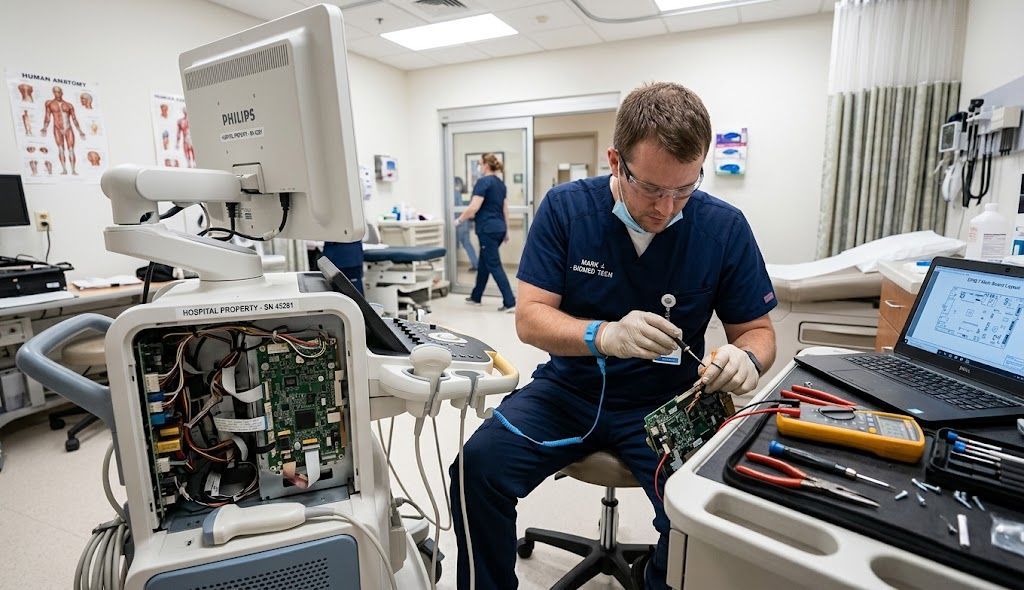

Philips vs. Mindray vs. Alpinion OB/GYN Ultrasound in 2026: Which Is Right for Your Practice?
Choosing an ultrasound system for a women's health practice has become more complex than simply comparing image quality, equipment specifications, and price.
Today's OB/GYN practices, maternal-fetal medicine programs, fertility clinics, and women's imaging centers expect more from their ultrasound technology.
They need systems capable of delivering consistent clinical imaging, supporting increasingly specialized examinations, improving sonographer workflows, integrating with existing information systems, and remaining productive throughout years of clinical use.
Three manufacturers deserve particular attention in that conversation: Philips, Mindray, and Alpinion.
Each offers ultrasound technology relevant to women's health, but the manufacturers approach clinical performance, system design, automation, portability, and equipment investment differently.
For healthcare organizations evaluating new ultrasound equipment in 2026, understanding those differences can help narrow the selection process.
The objective is not necessarily to identify which manufacturer makes the best ultrasound machine.
It is to determine which platform provides the right combination of clinical capability, workflow efficiency, service support, and long-term value for your organization.
Why Compare Philips, Mindray, and Alpinion?
Preferred Medical works with women's health providers evaluating ultrasound systems from Philips, Mindray, and Alpinion.
Across these manufacturers, there are options for high-volume hospital departments, established OB/GYN clinics, fertility programs, and growing outpatient practices.
Their portfolios also include systems with different approaches to workflow automation, advanced imaging, ergonomics, and mobility.
That variety is important.
A maternal-fetal medicine specialist performing detailed fetal examinations may prioritize different imaging capabilities than an OB/GYN practice conducting routine prenatal and gynecologic studies.
A fertility clinic may place greater emphasis on endovaginal imaging, follicular measurements, and efficient documentation.
Meanwhile, a multisite practice may prioritize standardized workflows, service availability, and the ability to move equipment between examination rooms.
Each clinical environment creates different purchasing priorities.
Understanding the strengths and intended applications of each manufacturer's systems is the first step toward a more productive equipment evaluation.
Philips Ultrasound: Advanced Imaging and a Software-Driven Platform Strategy
Philips has established a substantial presence in diagnostic ultrasound across hospitals, specialty departments, and outpatient imaging environments.
Within women's health, two platforms frequently enter the conversation: Philips EPIQ Elite and Philips Affiniti 70.
The EPIQ Elite represents Philips' premium ultrasound offering for demanding clinical environments. It deserves consideration when an organization needs advanced imaging performance, sophisticated clinical applications, and a broad range of compatible transducers.
For maternal-fetal medicine programs and hospitals managing complex imaging requirements, that capability can be particularly relevant.
The Affiniti 70 addresses a somewhat different clinical environment.
It provides advanced ultrasound imaging and workflow functionality for practices and departments that need dependable performance throughout a busy clinical schedule without necessarily requiring the full capabilities of a premium platform.
For a private OB/GYN practice, that distinction matters.
Purchasing a more advanced system does not automatically improve an imaging program if the organization rarely uses the additional capabilities.
Philips Elevate Plus and Workflow Automation
One of the more significant developments in Philips' 2026 portfolio is Elevate Plus.
Philips announced FDA 510(k) clearance for Elevate Plus on EPIQ Elite and Affiniti systems in June 2026, advancing its approach to image optimization, automation, and ultrasound workflow.
For women's health organizations, this reflects a broader change in how ultrasound technology should be evaluated.
Modern systems increasingly combine imaging capabilities with software-enabled functions that can assist clinicians with repetitive tasks, examinations, and workflow consistency.
That creates potential value for departments performing large numbers of similar examinations or managing multiple sonographers.
Philips also offers technologies associated with collaboration, connectivity, and system management that may be relevant for hospitals and multisite organizations.
The exact software, automation tools, and upgrade capabilities should always be verified for the specific system and configuration being purchased.
Who should consider Philips?
Philips deserves strong consideration from maternal-fetal medicine programs, hospitals, established OB/GYN practices, and women's imaging departments looking for advanced clinical functionality within a broader diagnostic ultrasound ecosystem.
For a more detailed examination of the platforms, read our guide: Philips Women's Health Ultrasound in 2026: EPIQ Elite, Affiniti 70 and Elevate Plus.
Mindray Ultrasound: Women's Health Specialization, Automation, and Ergonomics
Mindray offers a compelling set of ultrasound solutions for women's health providers seeking modern imaging technology, workflow efficiency, and clinical flexibility.
Within Preferred Medical's portfolio, three systems provide useful comparison points:
- Mindray Imagyn I9
- Mindray Resona I9T
- Mindray Consona N9
These platforms serve different clinical requirements rather than simply representing progressively higher equipment tiers.
Imagyn I9: A Platform Focused on Women's Health
The Imagyn I9 is particularly relevant because Mindray designed the platform specifically around women's health applications.
Its clinical focus includes obstetric and gynecologic imaging, with particular attention to workflow and ergonomics.
In high-volume ultrasound environments, ergonomic design is not simply a matter of operator preference.
Sonographers perform repetitive movements throughout their workday, including adjusting controls, positioning transducers, optimizing images, and completing measurements.
Equipment that supports comfortable positioning and efficient control access may contribute to a more sustainable working environment.
The Imagyn I9 incorporates an adjustable interface, customizable controls, and workflow technologies designed to support efficient imaging.
For practices performing primarily OB/GYN examinations, these features deserve consideration during a clinical demonstration.
Resona I9T and Consona N9: Broader Clinical Applications
The Resona I9T may be more appropriate for organizations needing advanced women's health imaging alongside general imaging, vascular, or other shared-service applications.
This versatility can be important for hospitals and multispecialty facilities.
The Consona N9 provides another option for growing practices seeking modern imaging and automation capabilities while balancing equipment investment with clinical needs.
Depending on configuration, Mindray's women’s health technologies include functions that assist with obstetric measurements, fetal visualization, and follicular assessment.
The practical value of these features should be established during a demonstration using examinations representative of the practice's normal workload.
Who should consider Mindray?
Mindray deserves consideration from dedicated OB/GYN clinics, fertility centers, high-volume women's health practices, and multispecialty imaging organizations looking to evaluate advanced automation and ergonomic design.
Learn more in our Mindray Women's Health Ultrasound in 2026: Imagyn I9, Resona I9T and Consona N9 guide.
Alpinion Ultrasound: Clinical Capability, Workflow Efficiency, and Flexible Configurations
Alpinion provides another important option for women's health providers evaluating ultrasound equipment in 2026.
The manufacturer's X-CUBE portfolio includes cart-based and compact systems intended for different imaging and operational environments.
Three models are particularly relevant to the discussion:
- Alpinion X-CUBE 90 with Elite
- Alpinion X-CUBE 70 with Elite
- Alpinion X-CUBE i9
X-CUBE 90 and X-CUBE 70: Cart-Based Imaging Solutions
The X-CUBE 90 with Elite is positioned toward organizations seeking higher-level imaging capabilities within a full-featured ultrasound platform.
It may be relevant for established OB/GYN practices, imaging departments, and fertility programs requiring a broad range of clinical applications.
The X-CUBE 70 with Elite provides another approach to advanced cart-based ultrasound.
For private practices, the X-CUBE 70 may represent an attractive comparison when the goal is to obtain appropriate imaging functionality without purchasing capabilities the organization does not expect to use.
The decision between these models should reflect the examinations performed, the required transducers, and the clinical capabilities available in each configuration.
Alpinion's Approach to Automation
Alpinion offers workflow technologies including X+ Auto Biometry, X+ Auto Follicle, and Auto NT.
These tools are intended to assist with specific imaging and measurement activities.
For fertility clinics, automated follicular assessment may be especially relevant because follicle identification and measurement are repeated frequently throughout treatment cycles.
For obstetric practices, automated biometric measurements may help streamline portions of routine fetal assessment.
These technologies do not replace clinical judgment.
Their value comes from supporting appropriately trained users while potentially reducing repetitive manual steps.
X-CUBE i9: When Mobility Matters
The X-CUBE i9 introduces a different purchasing consideration.
Its compact design emphasizes mobility and flexible deployment.
That can make it especially relevant for satellite practices, mobile imaging organizations, smaller examination rooms, and facilities that need to share ultrasound equipment across locations.
Portability should not automatically be interpreted as sacrificing important clinical functionality.
However, practices must still confirm that a compact system supports the necessary examinations, transducers, software, and reporting requirements.
Who should consider Alpinion?
Alpinion deserves consideration from private OB/GYN practices, fertility clinics, growing outpatient organizations, and providers evaluating equipment with different mobility and configuration requirements.
Explore the models in our Alpinion Women's Health Ultrasound in 2026: X-CUBE 90, X-CUBE 70 and X-CUBE i9 guide.
Philips vs. Mindray vs. Alpinion: A Practical Comparison
A useful comparison begins by identifying which platforms deserve further clinical evaluation.
ManufacturerSystems to EvaluateClinical ConsiderationsPhilipsEPIQ Elite, Affiniti 70Advanced imaging, software-driven workflow, broad clinical applications, and enterprise imaging requirementsMindrayImagyn I9, Resona I9T, Consona N9Women's health specialization, ergonomic design, automation, and shared-service flexibilityAlpinionX-CUBE 90, X-CUBE 70, X-CUBE i9Cart-based imaging, obstetric and fertility workflow tools, and compact/mobile configurations
This comparison is a starting framework, not a clinical performance ranking.
Features differ by model, software version, transducer package, and purchased options. Multiple manufacturers may be capable of meeting the same clinical requirements.
The meaningful differences become clearer when each platform is evaluated against the specific needs of the organization.
Seven Factors That Should Determine Your Ultrasound Decision
1. Clinical Examination Mix
Begin by documenting the examinations your organization performs today.
Routine obstetric imaging, gynecologic examinations, advanced fetal assessment, reproductive-medicine imaging, and breast ultrasound may require different combinations of imaging capability and transducers.
Do not assume every system within a manufacturer's portfolio supports every application in the same way.
The clinical requirement should define the equipment evaluation.
2. Transducers and Imaging Applications
The transducer package can substantially influence both the clinical value and total cost of an ultrasound purchase.
A practice may require curved-array abdominal probes, endocavitary transducers, volume imaging capabilities, or high-frequency linear probes.
Confirm that the quoted configuration includes the probes and applications necessary for the examinations being performed.
An apparently attractive equipment proposal can become less competitive once essential transducers and software options are added.
3. Workflow Automation
Automation is becoming increasingly relevant in women's health ultrasound.
However, not every automated feature will provide equal value to every practice.
A fertility clinic may benefit from evaluating automated follicular measurement tools, while a high-volume obstetric practice may focus on fetal biometric measurement workflows.
During a demonstration, observe how the technology performs with representative clinical examinations.
Measure the steps required to obtain, review, adjust, document, and store the relevant information.
The objective should be to improve clinical workflow, not simply accumulate additional features.
4. Sonographer Ergonomics
Ultrasound equipment should be evaluated by the clinicians who will use it regularly.
Consider monitor positioning, control-panel adjustment, transducer access, patient positioning, and the amount of reaching or repetitive movement required.
An otherwise impressive ultrasound platform may be less attractive if its physical design does not work comfortably within the practice's examination rooms.
Ergonomics should be considered part of the clinical evaluation rather than an afterthought.
5. Connectivity and Reporting
Modern ultrasound equipment must function within a larger clinical and information technology environment.
Before selecting a system, determine the organization's requirements for DICOM connectivity, worklists, image archiving, reporting, network security, and integration with relevant clinical systems.
Do not assume every ultrasound platform includes the same interfaces or that all integrations are available without additional licensing or configuration.
Involve clinical operations and information technology personnel early in the evaluation.
6. Warranty, Service, and Long-Term Support
Clinical capability is only part of the purchasing equation.
A system also needs to remain operational.
Evaluate warranty coverage, transducer protection, preventive maintenance, technical support, replacement parts, training, and service escalation procedures.
Ask who will support the system, what is covered, and how equipment problems will be addressed when the clinical schedule is full.
Service arrangements may vary by manufacturer, system condition, configuration, and purchase agreement.
The goal is to understand the complete support structure before making a commitment.
7. Total Cost of Ownership
Ultrasound purchasing decisions should be evaluated across the expected ownership period.
Consider the initial equipment price, necessary transducers, software, financing, maintenance, training, installation, and anticipated support costs.
A lower-priced system may represent excellent value if it meets the clinical requirements and offers appropriate long-term support.
A higher-priced configuration may also be justified when additional capabilities support examinations, workflows, or future expansion that the organization genuinely needs.
The important distinction is between purchasing cost and overall clinical value.
Which Ultrasound Brand Fits Different Women's Health Practices?
Although individual requirements vary, several common clinical scenarios can help narrow an evaluation.
For a high-volume maternal-fetal medicine program: Advanced imaging capabilities, specialty transducers, workflow consistency, and integration are likely to receive substantial attention. Philips EPIQ Elite is one logical starting point, alongside appropriately configured alternatives from other manufacturers.
For a dedicated OB/GYN clinic: Efficient obstetric and gynecologic examinations, sonographer ergonomics, and predictable workflow may carry greater importance. Systems worth comparing include Philips Affiniti 70, Mindray Imagyn I9, and Alpinion X-CUBE models.
For a fertility clinic: Endovaginal imaging, follicular assessment, repeatable measurements, and documentation become central considerations. Mindray and Alpinion workflow technologies deserve specific evaluation, alongside appropriate Philips configurations.
For a growing private practice: The organization may need advanced imaging capabilities while maintaining flexibility in its capital plan. Comparing Mindray Consona N9, Alpinion X-CUBE 70, and appropriate Philips platforms can help establish which configuration fits the examination mix.
For a multisite or mobile imaging organization: Mobility, standardization, service support, and equipment deployment become increasingly important. Compact systems such as the Alpinion X-CUBE i9 may warrant consideration, as may other mobile configurations.
None of these examples should be interpreted as a substitute for a clinical assessment.
They are starting points for determining which systems should be demonstrated and compared.
Why a Side-by-Side Ultrasound Demonstration Matters
Product descriptions and specification sheets provide valuable information.
They cannot fully demonstrate how ultrasound equipment will perform within a particular practice.
Whenever practical, healthcare organizations should evaluate competing systems using a consistent demonstration process.
Have the sonographers and physicians who will use the equipment participate.
Ask each vendor to demonstrate representative examination workflows rather than relying exclusively on prepared images or advanced features that may rarely be used.
Evaluate image quality, examination setup, measurements, transducer changes, reporting, ergonomics, and overall ease of use.
A consistent evaluation process makes it easier to distinguish meaningful workflow improvements from differences in marketing presentations.
It also creates a stronger foundation for making the final equipment decision.
Frequently Asked Questions About Philips, Mindray, and Alpinion Ultrasound
Is Philips better than Mindray or Alpinion for OB/GYN ultrasound?
There is no single answer that applies to every practice. All three manufacturers offer systems relevant to women's health imaging. The better choice depends on clinical applications, required transducers, available software, workflow preferences, service expectations, and budget.
Which ultrasound brand is best for a fertility clinic?
Fertility clinics should evaluate endovaginal imaging performance, follicular assessment, measurement workflows, and reporting capabilities. Depending on the system configuration, platforms from Philips, Mindray, and Alpinion may warrant consideration. A clinical demonstration is especially important.
Which manufacturer offers the most affordable OB/GYN ultrasound machine?
Equipment pricing depends on the selected model, software licenses, transducers, warranty, equipment condition, and acquisition arrangement. Comparing console prices alone does not establish which manufacturer offers the lowest-cost complete clinical solution.
Should a small OB/GYN practice consider a premium ultrasound system?
A premium system may be appropriate if the organization requires its advanced imaging or clinical applications. However, many practices should also evaluate midrange configurations that may support their entire examination mix with a different investment profile.
Can Preferred Medical help compare all three manufacturers?
Yes. Preferred Medical offers ultrasound solutions from Philips, Mindray, and Alpinion and works with healthcare organizations to evaluate clinical requirements, equipment configurations, transducers, training, service, and acquisition options.
Making the Right Ultrasound Investment in 2026
Philips, Mindray, and Alpinion each bring meaningful capabilities to the women's health ultrasound market.
Philips offers advanced imaging platforms and a continued emphasis on software-enabled workflow.
Mindray combines women's health-focused solutions with ergonomic design, automation, and broader imaging capabilities across its portfolio.
Alpinion provides cart-based and compact ultrasound systems with workflow technologies relevant to obstetric and fertility applications.
But choosing between these manufacturers should never come down to brand recognition alone.
The right ultrasound investment is the one that supports the examinations your organization performs, fits the clinicians who use it, integrates with the clinical environment, and remains dependable throughout its intended ownership period.
That requires a more complete conversation about imaging capabilities, configuration, cost, workflow, service, and future growth.
Compare Women's Health Ultrasound Systems With Preferred Medical
For more than 35 years, Preferred Medical has helped healthcare providers navigate diagnostic ultrasound equipment decisions.
Today, we work with OB/GYN practices, maternal-fetal medicine specialists, fertility centers, hospitals, and women's health organizations to identify ultrasound solutions aligned with their clinical and operational needs.
Our approach goes beyond providing equipment quotations.
We help organizations consider clinical applications, transducer selection, installation, customized applications training, acquisition options, and long-term service requirements.
Evaluating Philips, Mindray, or Alpinion ultrasound systems for your practice?
Contact Preferred Medical to discuss your examination requirements, compare appropriate ultrasound configurations, and develop an equipment strategy designed around your patients, clinicians, and plans for growth.

Should You Buy, Finance, or Lease an OB/GYN Ultrasound Machine in 2026? A Practice Acquisition Guide

How Many Scans Does It Take to Pay for an OB/GYN Ultrasound Machine? A 2026 ROI and Break-Even Guide