OB/GYN Ultrasound Service and Preventive Maintenance in 2026: A Guide to Uptime, Probes, QA, and Support
An ultrasound service plan is easy to overlook when a system is new, working well, and covered by a warranty.
Its value becomes much more visible when the schedule is full and something stops working.
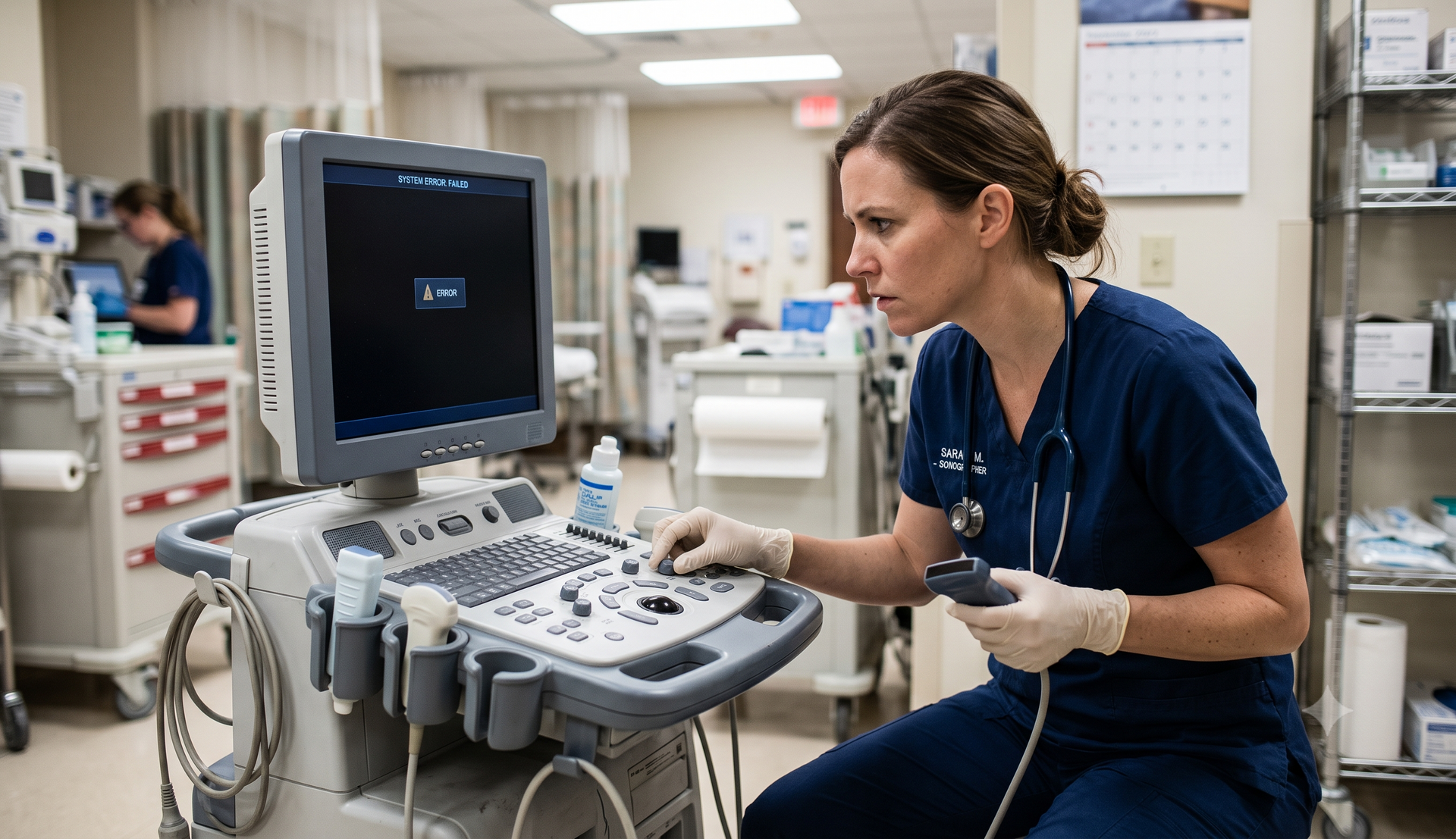
A failed transducer, intermittent system error, network problem, damaged connector, software issue, or unexpected console failure can affect more than the equipment itself. It can change room assignments, interrupt examinations, require patients to be rescheduled, create additional work for staff, or force studies to be redirected.
For an OB/GYN practice, maternal-fetal medicine program, fertility clinic, women’s imaging center, or hospital department, equipment support should therefore be planned as part of the ultrasound lifecycle—not as an emergency purchase after the first major problem.
The important question is not simply, “Do we have a service contract?”
It is: “If this ultrasound system or one of its critical transducers has a problem tomorrow, do we know who will respond, what is covered, how the issue will be escalated, and how we will protect the clinical schedule?”
Warranty, Service, Preventive Maintenance, and Quality Assurance Are Not the Same Thing
These terms are sometimes used interchangeably, but practices should understand exactly what each agreement or activity covers.
Warranty
A warranty generally defines the manufacturer’s or seller’s obligations for covered failures during a defined period. Coverage may differ for the console, transducers, accessories, software, labor, travel, and other components.
Never assume that every part of the system carries identical terms.
Service Agreement
A service agreement may provide support after—or in addition to—the original warranty.
Depending on the agreement, it may address:
- Phone support
- Remote diagnostics
- On-site repair
- Labor
- Travel
- Replacement parts
- Preventive maintenance
- Transducer coverage
- Software support
- Loaner equipment
- Response commitments
The details matter more than the name of the plan.
Preventive Maintenance
Preventive maintenance commonly refers to scheduled equipment inspection and servicing intended to identify or address issues before an unexpected failure occurs.
The exact tasks should be documented in the service agreement or manufacturer requirements.
Equipment Quality Assurance
Quality assurance has a broader clinical and documentation purpose.
AIUM’s current accreditation standards state that ultrasound equipment should be kept in optimal operating condition and undergo documented quality-assurance testing at least annually, or more often if problems arise. Its accreditation FAQ specifically describes annual equipment evaluation requirements.
A service visit should therefore not automatically be assumed to satisfy every accreditation, quality, regulatory, or organizational requirement.
Practices should understand what the service provider performs and what the organization remains responsible for documenting.
1. Start With a Complete Equipment Inventory
A service strategy begins with knowing exactly what needs support.
For every ultrasound system, record:
- Manufacturer
- Model
- Serial number
- Approximate age
- Software revision
- Location
- Primary clinical use
- Installed options
- Transducers
- Accessories
- Warranty status
- Service agreement
- Renewal date
- Previous repairs
- Known limitations
For multisite groups, maintain one centralized inventory rather than separate undocumented lists at each office.
That allows leadership to identify equipment that is nearing the end of warranty coverage, repeatedly requiring repair, or becoming difficult to support.
2. Define Who Responds First
When a machine stops working, staff should not have to determine the support pathway in real time.
Define:
- Primary service contact
- After-hours contact
- Remote-support process
- On-site escalation process
- Internal IT contact
- Biomedical contact when applicable
- Applications-support contact
- Vendor account information
- System serial number and location
Post that information where staff can find it without searching through old emails or purchase files.
It is also useful to define which problems should go first to IT, which should go to applications support, and which require technical field service.
Not every apparent equipment failure is a failed component.
A worklist problem may involve the network. A preset problem may require applications support. A damaged probe may require a different pathway than a software issue.
Clear triage can reduce unnecessary delays.
3. Understand Response Time—Precisely
“Fast service” is not a complete service commitment.
Before purchasing or renewing coverage, ask what response terminology actually means.
For example:
- Does response time mean a returned phone call?
- Does it mean remote diagnosis?
- Does it mean an engineer is dispatched?
- Does it mean arrival on-site?
- Does it vary by geography?
- Are weekends included?
- Are holidays included?
- Are there different service levels?
- What happens if a required part is unavailable?
A practice performing a few studies each week may tolerate a different response model than a high-volume MFM department with a tightly booked schedule.
Select support based on the operational consequence of downtime, not simply the lowest service-plan price.
4. Review Parts, Labor, and Travel Coverage
A service agreement should make clear which expenses are included.
Ask specifically about:
- Technical labor
- Travel
- Replacement components
- Shipping
- Software troubleshooting
- Preventive service visits
- Emergency visits
- After-hours support
- Accessories
- Peripherals
- Batteries
- Printers
- Storage devices
- Network-related work
A plan that sounds comprehensive may still contain exclusions that materially affect ownership cost.
Request those exclusions before the contract is signed.
5. Treat Transducers as Their Own Service Category
An ultrasound console can be functioning perfectly while a critical transducer is unavailable.
For women’s health imaging, this can be especially disruptive when the failed probe is necessary for a specific examination type.
A service review should document:
- Which probes are covered
- Whether accidental damage is covered
- Whether cable or connector damage is covered
- Whether probe evaluation is available
- Whether repair is possible
- When replacement is required
- Whether loaner transducers are available
- Expected turnaround time
- Shipping responsibilities
- Coverage limits
Track transducer service history separately.
Repeated failures may reveal a handling, storage, cleaning, cable-management, or equipment-aging issue that deserves broader investigation.
Preferred Medical currently states that it supplies new and pre-owned replacement parts and probes for major ultrasound manufacturers in addition to equipment service.
6. Ask About Remote Diagnostics
Remote support can be useful when the problem can be evaluated without waiting for an on-site visit.
Depending on the platform and service arrangement, remote troubleshooting may help identify:
- Error conditions
- Configuration problems
- Connectivity issues
- Software concerns
- Workflow problems
- Whether an on-site engineer is required
Remote access must still operate within the organization’s approved network and cybersecurity practices.
The FDA identifies cybersecurity for connected medical devices as a shared responsibility between manufacturers and healthcare delivery organizations and advises healthcare organizations to evaluate and protect their networks.
Before activating remote service, involve the appropriate IT or security personnel and document how access will be authorized.
7. Put Scheduled Maintenance and QA on the Calendar
Routine equipment attention should not depend on someone remembering when a year has passed.
Create recurring calendar events for:
- Required equipment quality assurance
- Vendor maintenance
- Warranty renewal
- Service-contract renewal
- Probe inspection
- Software review
- Equipment inventory review
- Staff training review
AIUM’s accreditation guidance requires documented ultrasound equipment QA at least annually for accredited practices and more frequently when issues arise.
Organizations should follow the requirements applicable to their own accreditation, state, manufacturer, facility, and clinical environment.
The operational advantage of scheduling these activities is simple: the organization can plan around them instead of discovering that documentation or service is overdue when another need arises.
8. Review Software and Connectivity Support
Ultrasound service is increasingly about more than mechanical hardware.
A technically operational system may still create problems if it cannot communicate reliably with the practice’s technology environment.
Determine who supports:
- DICOM configuration
- PACS connectivity
- Modality worklist
- Reporting integration
- User authentication
- Software updates
- Operating-system issues
- Remote-service software
- Data export
- Storage
- Network changes
Also identify where the equipment vendor’s responsibility ends and the organization’s IT or third-party vendor responsibility begins.
That boundary should be clear before an outage.
9. Include Applications Support in the Ownership Strategy
Sometimes the system is functioning as designed, but users are not obtaining the expected workflow or image performance.
Examples can include:
- Inefficient presets
- Measurements in the wrong sequence
- Difficulty with 3D/4D acquisition
- Unused automation features
- Reporting workflow problems
- New employees who were not present at installation
- Expanded clinical applications
- Inconsistent configuration between rooms
Those issues may call for applications training rather than technical repair.
Preferred Medical says its applications training is tailored to specialty, equipment, workflow, and user experience and includes ongoing and follow-up support options.
Practices should know how to request both types of help.
Technical service keeps the equipment functioning. Applications support helps the clinical team use that functionality effectively.
10. Decide What Happens During Extended Downtime
Even a strong service plan cannot guarantee that every failure will be resolved immediately.
Create a downtime plan before one is needed.
Questions may include:
- Can examinations move to another room?
- Is another location nearby?
- Can physicians or sonographers redistribute schedules?
- Are loaner systems available?
- Are loaner probes available?
- Which examinations can be rescheduled safely under organizational policy?
- Which studies would need to be referred?
- Who communicates schedule changes?
- Who decides when the room returns to service?
The answers will vary by organization.
What matters is that staff are not designing the contingency plan while simultaneously responding to the failure.
11. Keep a Meaningful Service History
Service records become more valuable as equipment ages.
For each event, document:
- Date
- Reported problem
- Error message when applicable
- System or probe involved
- Downtime
- Remote troubleshooting performed
- On-site visit
- Parts replaced
- Repair cost if relevant
- Whether the issue recurred
- Effect on the clinical schedule
- Follow-up action
Over time, this information helps distinguish an isolated repair from a pattern.
That matters because the decision to replace an ultrasound machine should not be based solely on age.
Preferred Medical’s current replacement guide recommends considering reliability, service frequency, parts and transducer availability, software support, workflow, integration, and the total cost of continuing to operate the system.
A well-maintained service record makes that evaluation more objective.
12. Review the Service Plan Before the Warranty Expires
Do not wait until the final week of warranty coverage.
Several months before expiration, review:
- Current reliability
- Repair history
- Probe condition
- Current clinical needs
- Software support
- Parts availability
- Service options
- Renewal cost
- Replacement plans
- Expected ownership period
Then decide whether the appropriate next step is:
- Extended coverage
- A new service agreement
- Time-and-material support
- Equipment upgrade
- Planned replacement
The answer may be different for each machine in a multisite fleet.
What Should an OB/GYN Ultrasound Service Contract Include?
There is no universal contract that is right for every practice.
Before signing, ask at least these questions:
- Which exact ultrasound systems are covered?
- Which transducers are covered?
- Are parts included?
- Is labor included?
- Is travel included?
- Is remote support included?
- What constitutes a service response?
- What on-site response commitment is offered?
- What geographic limitations apply?
- Is scheduled maintenance included?
- Are equipment QA activities included or separate?
- Are software updates covered?
- Who supports connectivity?
- Are loaner probes available?
- Are loaner systems available?
- What exclusions apply?
- Are there repair-cost limits?
- Is accidental damage covered?
- How are recurring failures handled?
- How is the agreement renewed?
- Can the price change at renewal?
- What happens when parts become unavailable?
- What support remains available after OEM support changes?
- Who maintains the service documentation?
If the answers are unclear, ask for them in writing.
Service Planning for Multisite OB/GYN Groups
Service becomes more complex as organizations add locations.
Different sites may have:
- Different system generations
- Different manufacturers
- Different software versions
- Different transducers
- Different service agreements
- Different renewal dates
- Different workflows
- Different support contacts
That fragmentation can make coverage harder to manage.
A fleet-level service strategy can help leadership identify opportunities to standardize:
- Equipment inventories
- Support contacts
- Escalation procedures
- Renewal dates
- Presets
- Software levels
- Training
- Spare or backup equipment
- Replacement timing
Standardization does not require every location to operate the identical premium system.
It means reducing unnecessary complexity while maintaining equipment configurations appropriate for each site’s examination mix.
When Is Repair No Longer the Best Choice?
An equipment failure does not automatically mean the machine should be replaced.
Repair may remain reasonable when:
- The problem is isolated.
- Parts remain available.
- The system still meets clinical requirements.
- Qualified service is readily available.
- Software remains supportable.
- Reliability remains acceptable.
Replacement deserves stronger consideration when:
- Failures recur.
- Downtime becomes unpredictable.
- Critical parts or probes become difficult to source.
- Software support becomes limited.
- The platform cannot support required clinical applications.
- Connectivity becomes increasingly difficult.
- Several limitations appear simultaneously.
That decision should compare the cost and operational implications of both paths rather than assuming newer equipment is always the answer.
Frequently Asked Questions
How often should an ultrasound machine receive preventive maintenance?
The appropriate schedule depends on manufacturer requirements, equipment condition, organizational policies, service agreements, accreditation requirements, and applicable regulations. AIUM accreditation standards require documented equipment QA at least annually and more frequently if issues arise.
Is preventive maintenance the same as ultrasound QA testing?
Not necessarily. Vendor maintenance and equipment QA may involve different procedures and documentation. Practices should verify exactly what each service includes and what their accreditation or organizational requirements specify.
Should ultrasound probes be included in a service agreement?
Practices should evaluate probe coverage carefully because a failed specialty transducer can limit the examinations a functioning console can perform. Confirm whether individual probes are covered, what types of damage qualify, and whether repair, replacement, or loaner options are available.
What records should a practice keep after an ultrasound repair?
Maintain the date, reported problem, system or transducer involved, diagnosis, repair performed, parts replaced, downtime, recurrence, and relevant service documentation.
When should a practice replace instead of repair an ultrasound machine?
There is no single age or repair threshold appropriate for every organization. Replacement becomes more compelling when reliability, supportability, software, parts availability, clinical capability, workflow, and ownership cost begin deteriorating together.
Protect the Ultrasound Investment With a Planned Service Strategy
The best time to establish an ultrasound support plan is before the system fails.
Preferred Medical currently describes its field-service program as including remote diagnostics, scheduled preventive maintenance, flexible service plans, and field support. Its website says Philips-backed service resources support its program nationally, with additional regional support through Tri-Star Medical Technologies in the Southeast; exact coverage should be confirmed for the system, geography, and agreement being considered.
Preferred Medical also supports women’s health organizations with ultrasound equipment planning, applications training, parts and probes, upgrades, and replacement discussions.
Whether your organization operates one OB/GYN ultrasound room or manages systems across multiple locations, service planning should answer the same fundamental question:
How will we keep the equipment clinically appropriate, supportable, and ready for the work our team depends on it to perform?
Request an ultrasound service and lifecycle review with Preferred Medical to evaluate your current systems, transducers, warranty status, service history, support needs, and future replacement plans.
Recommended Articles





Should You Buy, Finance, or Lease an OB/GYN Ultrasound Machine in 2026? A Practice Acquisition Guide


How Many Scans Does It Take to Pay for an OB/GYN Ultrasound Machine? A 2026 ROI and Break-Even Guide