
OB/GYN Ultrasound Machine Cost in 2026: Pricing, Features, and Total Cost of Ownership
Purchasing an ultrasound machine is one of the most important technology investments an OB/GYN practice, maternal-fetal medicine program, fertility clinic, or women’s imaging center can make.
The right system can support efficient examinations, improve workflow consistency, expand imaging capabilities, and help clinical teams deliver a more streamlined patient experience. The wrong configuration can leave a practice paying for features it rarely uses—or discovering too late that important transducers, software packages, training, or service coverage were not included.
So, how much does an OB/GYN ultrasound machine cost in 2026?
The answer depends on much more than the name printed on the system. Equipment condition, clinical applications, transducer selection, 3D/4D capabilities, workflow tools, service coverage, training, integration, and financing can all affect the final investment.
Publicly advertised dealer pricing for several commonly evaluated women’s health systems currently ranges from approximately $24,000 to more than $80,000, depending on the model, age, condition, and configuration. Entry-level or compact equipment may fall below that range, while premium current-generation maternal-fetal medicine systems with advanced transducers and software are frequently quote-based and may require a significantly larger budget.
For that reason, practices should evaluate the complete clinical and financial package—not simply the initial system price.
How Much Does an OB/GYN Ultrasound Machine Cost?
A practical 2026 planning range for an OB/GYN ultrasound purchase may look like this:
| System category | General budget range | range Common applications |
|---|---|---|
| Handheld or basic point-of-care ultrasound | Under $15,000 | Limited bedside assessments, procedural guidance, focused examinations |
| Compact or portable ultrasound | $15,000–$35,000 | Office-based imaging, mobile services, space-constrained practices |
| Mid-range cart-based OB/GYN system | $25,000–$50,000 | Routine obstetrics, gynecology, pelvic imaging, basic 3D/4D |
| Advanced women’s health system | $40,000–$80,000 | Higher-volume OB/GYN, fertility, advanced 3D/4D, automation |
| Premium MFM or shared-service platform | Premium MFM or shared-service platform | High-risk obstetrics, fetal imaging, complex gynecology, breast or multispecialty imaging |
These ranges are intended for initial budgeting rather than formal quoting. A system advertised at one price may not include the transducers, software licenses, installation, warranty, training, delivery, or connectivity required by a particular practice.
Some publicly listed 2026 configurations place mid-range women’s health systems around $24,000 to $50,000 and premium or shared-service systems between approximately $47,500 and $80,500. Actual new-system pricing may be higher, particularly when a practice adds advanced volume transducers, specialized fetal imaging capabilities, extended warranty coverage, or multiple clinical packages.
The most useful question is therefore not simply, “What does the machine cost?”
It is: What will it cost to equip, implement, support, and operate the right system for our practice?
What Determines the Price of a Women’s Health Ultrasound Machine?
Two ultrasound systems that appear similar in a product photograph can have very different prices. The following factors usually create the largest differences.
1. New, Demonstration, Pre-Owned, or Refurbished Condition
Equipment condition is one of the biggest cost variables.
A new ultrasound system generally provides access to the latest hardware, current software, manufacturer warranty coverage, and the longest expected service life. It may also provide a clearer upgrade pathway as new features become available.
A demonstration system may have been used for exhibitions, training, or customer evaluations. Demo equipment can offer relatively current technology at a lower acquisition cost, although availability is limited and configurations vary.
A pre-owned system is sold after previous clinical use. Its value depends heavily on age, software level, service history, probe condition, operating environment, and whether replacement parts remain readily available.
A professionally refurbished system should be inspected, tested, cleaned, repaired as needed, and verified for performance before installation. The quality of the refurbishment process—and the support offered afterward—is more important than the label alone.
Preferred Medical reports that its certified pre-owned equipment can offer savings of approximately 40% to 60% compared with new systems, with warranty options available. The exact savings depend on the model, age, inventory, and configuration.
For many growing OB/GYN practices, a carefully selected refurbished or demonstration system can create a path to advanced imaging capabilities without requiring the budget of a fully configured new platform.
2. Cart-Based, Compact, or Handheld Design
System format influences both price and clinical capability.
A handheld ultrasound device may be appropriate for focused point-of-care applications, but it may not provide the imaging performance, ergonomic controls, reporting tools, transducer selection, or advanced OB/GYN functionality required for a full diagnostic women’s health program.
Compact systems offer greater mobility and a smaller footprint. They may work well for satellite offices, labor and delivery environments, mobile services, or practices with limited examination-room space.
Cart-based systems typically provide larger displays, more transducer ports, broader software options, improved ergonomics, and greater processing power. They remain a common choice for high-volume OB/GYN, fertility, maternal-fetal medicine, and imaging departments.
The least expensive format is not always the most economical. A compact system that slows examinations or cannot support future services may cost more over time than a properly configured cart-based platform.
3. Transducer Selection
Transducers are central to both imaging performance and system price.
A routine OB/GYN configuration may include:
- An endocavitary transducer for transvaginal imaging
- A curved-array transducer for abdominal and obstetric examinations
- A volume transducer for 3D/4D imaging
- A linear transducer for breast, vascular, superficial, or procedural applications
- A specialized transducer for fetal cardiac or advanced maternal-fetal medicine imaging
Adding several new transducers can materially increase the total quote. Volume and specialty probes generally cost more than basic conventional probes.
Practices should also ask whether transducers are covered under the system warranty or service agreement. Probe failure can create an unplanned expense and may interrupt patient scheduling if a replacement or loaner is not readily available.
4. 3D and 4D Imaging Capabilities
Three-dimensional ultrasound captures volumetric data that can be reconstructed and reviewed in multiple planes. Four-dimensional ultrasound adds real-time movement to volume imaging.
These capabilities may be valuable in obstetrics, gynecology, reproductive medicine, and other women’s health applications. However, the presence of a “3D/4D” label does not mean every system provides the same image quality, rendering performance, workflow, or measurement tools.
A complete 3D/4D package may require:
- A compatible volume transducer
- Licensed volume-imaging software
- Rendering or visualization tools
- Specialized measurement applications
- Additional storage or data-management capabilities
- Clinical applications training
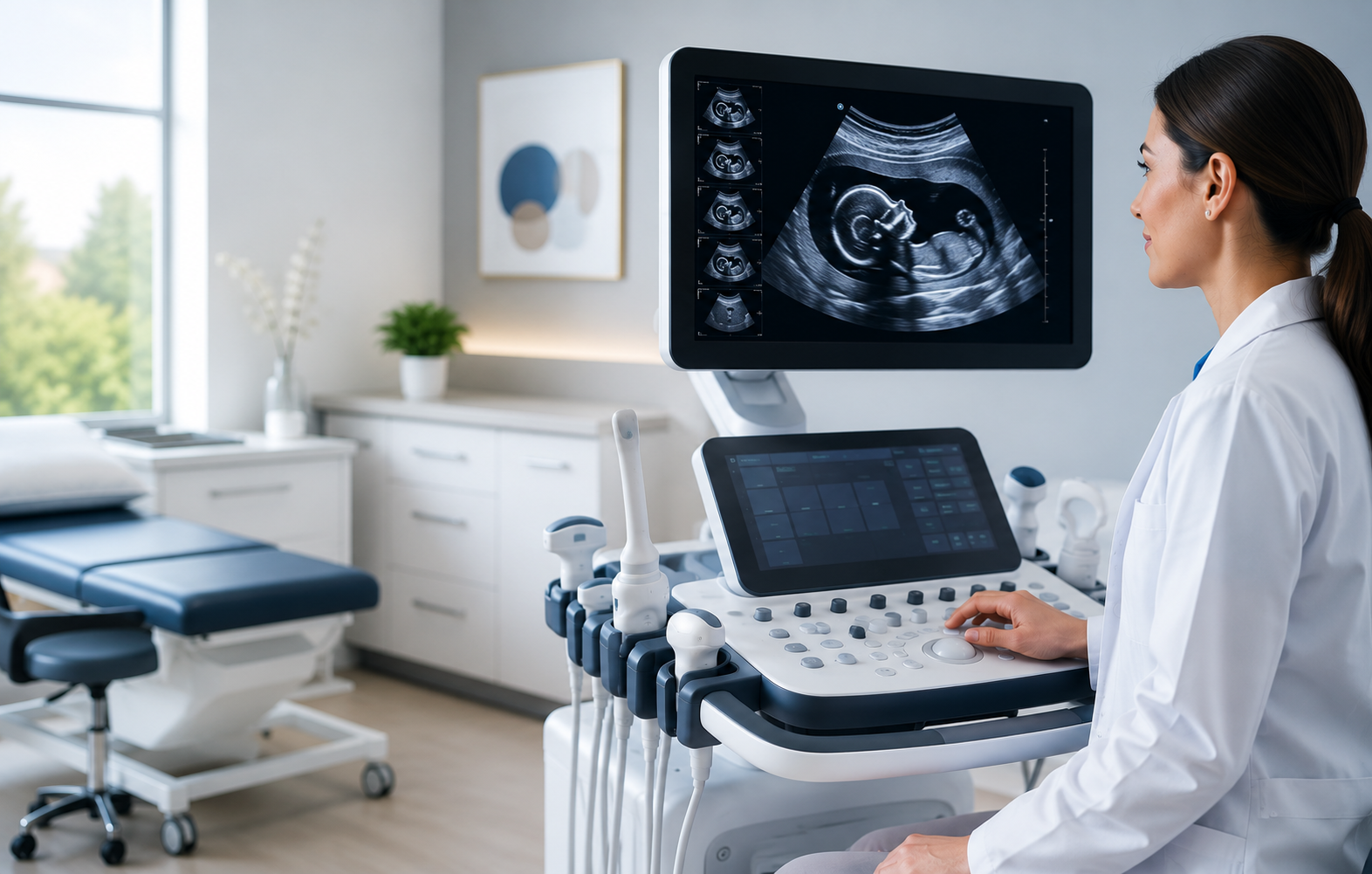
Practices should request a demonstration using the examinations and patient populations they routinely encounter. Image quality should be evaluated by the clinicians and sonographers who will use the equipment—not solely through promotional images.
5. OB/GYN and MFM Software Packages
Software can substantially affect the final system price.
Depending on the platform, optional packages may include automated obstetric measurements, fetal growth calculations, multiple-gestation tools, pelvic-floor imaging, follicular assessment, fetal cardiac applications, elastography, contrast imaging, breast imaging, reporting, or remote collaboration.
Some current systems also offer AI-assisted presets, automated measurements, and workflow features intended to reduce repetitive steps and support greater examination consistency. Philips, for example, has added AI-assisted workflow and quantitative measurement capabilities to portions of its EPIQ Elite and Affiniti portfolios, including expanded presets for OB/GYN applications.
Automation should be evaluated as a workflow tool rather than purchased simply because it is new. Buyers should determine whether a feature addresses a real clinical or operational need, whether it is included or licensed separately, and whether staff will receive training on its use.
6. Specialty-Specific Versus Shared-Service Capability
A specialty-specific women’s health system is designed around obstetric and gynecologic examinations. It may offer dedicated presets, measurements, reporting tools, transducers, and control layouts for that clinical environment.
A shared-service platform supports multiple departments or specialties, such as OB/GYN, general imaging, vascular, breast, and cardiology. Shared-service systems may cost more, but they can provide additional flexibility for hospitals, multispecialty groups, and physician-owned diagnostic centers.
The correct choice depends on case mix.
A private OB/GYN group performing primarily routine obstetric and pelvic examinations may not need the same system as an MFM center conducting complex fetal studies. Conversely, an imaging center planning to perform breast, abdominal, vascular, and women’s health examinations may benefit from a broader platform.
Preferred Medical currently offers a portfolio of Philips, Mindray, and Alpinion systems across women’s health, maternal-fetal medicine, out-of-hospital imaging, and point-of-care applications.
7. Image Storage, Reporting, and Connectivity
An ultrasound system must fit into the practice’s broader information environment.
Potential integration expenses include:
- DICOM connectivity
- PACS integration
- Electronic health record connectivity
- Structured reporting
- Worklist management
- Image archiving
- Cybersecurity requirements
- Network configuration
- Remote access or collaboration tools
A lower-priced machine that requires substantial additional work to connect with existing systems may not represent the best overall value.
Before purchasing, practices should involve clinical users, administration, information technology, and biomedical engineering when appropriate. Confirm who is responsible for connectivity, whether integration is included in the quote, and what ongoing software or support fees may apply.
8. Warranty and Service Coverage
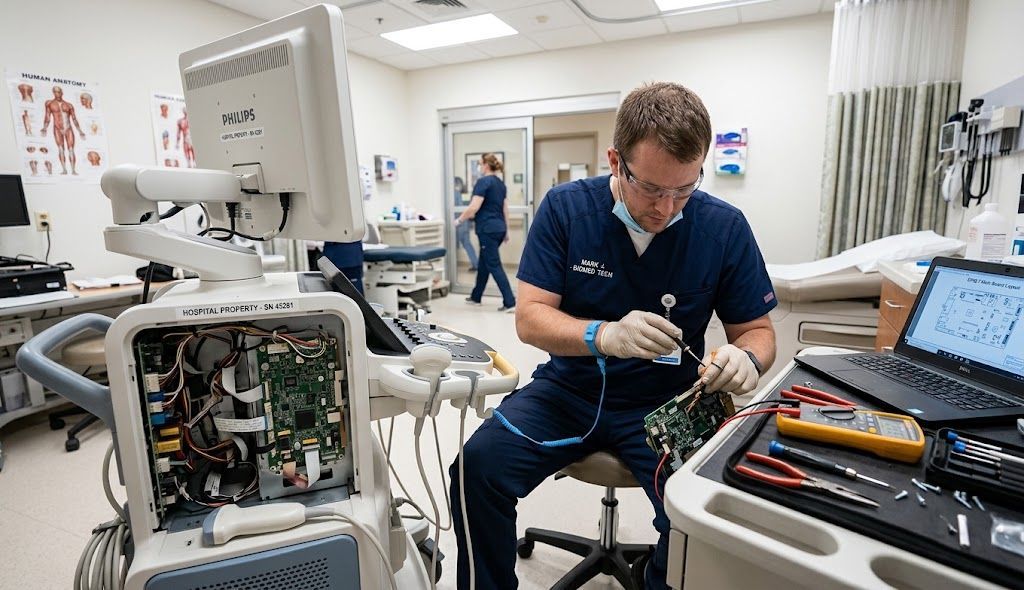
Service is one of the most frequently underestimated components of ultrasound ownership.
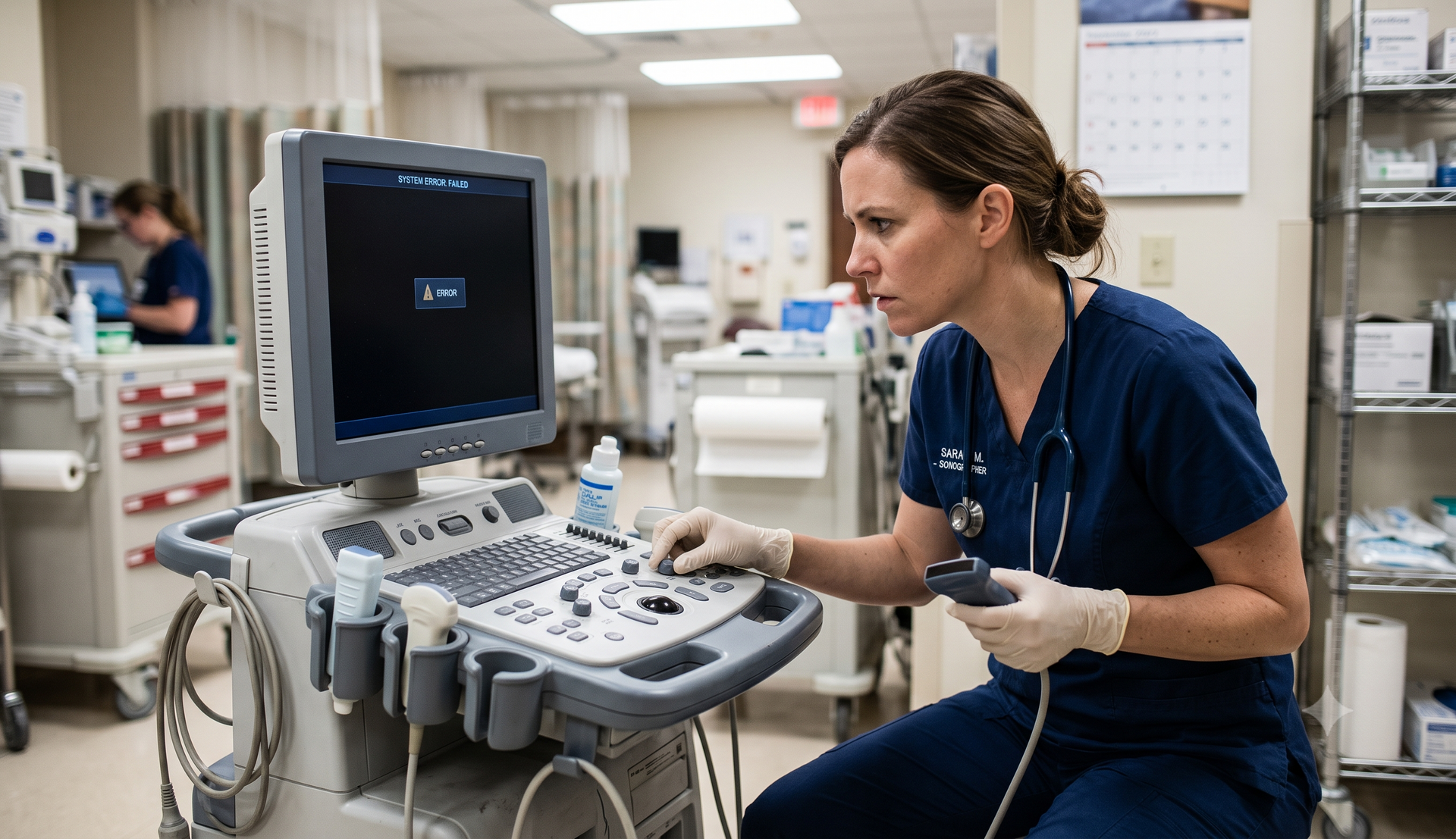
Equipment downtime can disrupt patient schedules, delay examinations, reduce revenue, and create pressure on staff. A strong service plan can be more valuable than a modest discount on the purchase price.
Buyers should ask:
- How long is the warranty?
- Does it include labor, travel, parts, and transducers?
- Is preventive maintenance included?
- What response time is offered?
- Are local or regional engineers available?
- Is telephone or remote support included?
- Are loaner systems or probes available?
- What happens when the warranty expires?
- Are software updates included?
- Can the agreement be renewed at a predictable cost?
Preferred Medical emphasizes hands-on training, ongoing field service, troubleshooting assistance, software support, and workflow optimization. Its website also states that new systems include five-year warranty coverage, although buyers should confirm the exact terms for the selected equipment and agreement.
9. Applications Training
Even an advanced ultrasound platform will underperform if users are not comfortable operating it.
Training may include system setup, image optimization, presets, measurements, reporting, 3D/4D acquisition, workflow configuration, data management, and specialty applications.
When comparing quotes, determine:
- Whether training is included
- Whether it is on-site or virtual
- How many days or sessions are provided
- Whether training is customized to the specialty
- Whether new employees can receive future instruction
- Whether follow-up optimization is available
- Whether the trainer has women’s health experience
Preferred Medical states that its systems include customized applications training delivered by experienced clinical specialists, with on-site and virtual options tailored to the equipment, specialty, and workflow.
Training should not be treated as an optional extra. It is part of the implementation cost and directly influences how quickly the practice can use its new technology effectively.
New Versus Refurbished Ultrasound: Which Is Better?
Neither option is automatically better for every organization.
A New System May Be the Better Choice When:
- The practice wants the latest hardware and software
- Advanced MFM or specialty applications are required
- A long warranty is a high priority
- The organization expects to operate the system for many years
- Future upgrades and compatibility are important
- Standardization across multiple locations is planned
- The capital budget supports a new-equipment purchase
A Refurbished or Pre-Owned System May Be the Better Choice When:
- The practice has a defined budget
- A proven older platform meets the clinical requirements
- The organization is opening a satellite office
- The system will serve as a backup or secondary unit
- Advanced features are desired at a lower acquisition price
- The equipment has been professionally tested and documented
- Warranty, parts, probes, and service remain available
The condition of the system matters more than whether it is described as “used.”
Ask for the year of manufacture, software revision, probe condition, service history, refurbishment process, warranty terms, parts availability, and expected installation date. A reputable vendor should be able to explain what was tested and what support will be provided after delivery.
Understanding the Total Cost of Ownership
The initial equipment quote is only one part of the investment.
A five-year cost analysis should consider:
System acquisition: The base equipment and required hardware.
Transducers: All probes needed at launch, plus anticipated replacement costs.
Software: Clinical packages, reporting modules, automation, upgrades, and recurring licenses.
Installation: Delivery, room preparation, networking, testing, and system configuration.
Training: Initial education, advanced applications support, and onboarding for future employees.
Service: Warranty coverage, preventive maintenance, repairs, labor, travel, parts, and loaners.
Financing: Interest, fees, lease terms, end-of-term obligations, and purchase options.
Downtime: Lost appointments, outsourced examinations, rescheduling, and staff disruption.
Technology lifecycle: Future upgrades, trade-in value, expected support period, and eventual replacement.
A $40,000 system with limited training and service could ultimately cost more than a $50,000 system with a stronger warranty, dependable support, and the correct transducer package.
Practices should request an itemized proposal and compare the full package over the expected ownership period.
How Practice Type Influences the Right Budget
Private OB/GYN Practices
A private OB/GYN office may prioritize reliable 2D imaging, endovaginal and abdominal transducers, efficient measurements, straightforward reporting, ergonomics, and manageable ownership costs.
A mid-range cart-based or compact system may provide the best balance. Practices offering 3D/4D imaging should confirm that the quote includes the necessary volume transducer and software.
Maternal-Fetal Medicine Programs
MFM programs often require premium imaging, specialized fetal applications, advanced Doppler, fetal cardiac capabilities, high-performance transducers, collaboration tools, and sophisticated measurement packages.
Image quality and advanced functionality generally take priority over obtaining the lowest acquisition price. Service responsiveness may also be critical because downtime can affect high-risk pregnancy schedules and referral relationships.
Fertility and Reproductive Medicine Clinics
Fertility practices may focus on transvaginal image quality, follicular assessment, measurement efficiency, needle-guidance support, reporting, and a system footprint that works in examination or procedure rooms.
The system should be evaluated using the clinic’s actual workflow, particularly when rapid, repeatable measurements are important.
Women’s Imaging and Breast Centers
A center performing both pelvic and breast ultrasound may need a shared-service platform, high-frequency linear transducers, elastography options, structured reporting, and integration with existing image-management systems.
The practice should confirm that the selected platform is configured for every intended application rather than purchasing an OB/GYN system and attempting to add unrelated capabilities later.
Hospitals and Multisite Organizations
Hospitals and health systems may prioritize standardization, service-network coverage, cybersecurity, connectivity, biomedical support, fleet management, training across shifts, and future scalability.
The lowest individual system price may be less important than consistency, uptime, supportability, and the ability to manage several systems across multiple locations.
Purchase, Lease, or Finance?
Healthcare organizations do not always need to pay the full equipment cost upfront.
Common acquisition options include:
- Cash purchase
- Traditional equipment financing
- Operating or capital lease structures
- Lease-to-own arrangements
- Demonstration equipment
- Certified pre-owned equipment
- Trade-in credit
- Phased equipment upgrades
A purchase may provide the lowest long-term cost when capital is available and the practice expects to retain the system for many years.
Financing or leasing may help preserve working capital and create a predictable monthly expense. However, practices should evaluate interest, fees, insurance requirements, tax treatment, end-of-term obligations, and the total amount paid.
Preferred Medical offers financing and leasing options, including monthly-payment and lease-to-own structures, subject to the terms of the specific transaction and financing provider.
Financial and tax decisions should be reviewed with the organization’s accountant, lender, or financial advisor.
Questions to Ask Before Requesting an Ultrasound Quote
A useful quote request should provide more information than “We need an OB/GYN machine.”
Before contacting a vendor, document:
- Which examinations will be performed?
- How many studies are expected each day?
- Which transducers are required?
- Is 3D/4D imaging needed?
- Are advanced fetal or gynecologic applications required?
- Will the system support breast, vascular, cardiac, or general imaging?
- Does the equipment need to move between rooms?
- How much space is available?
- Which reporting, PACS, or EHR systems must be connected?
- What level of applications training is needed?
- What warranty and response time does the practice expect?
- Is new, demo, or refurbished equipment preferred?
- Is financing or leasing being considered?
- Is there existing equipment available for trade-in?
- What is the target installation date?
The more clearly a practice communicates its clinical and operational requirements, the more accurately a vendor can configure the system.
Common Ultrasound Purchasing Mistakes
Comparing Only the Base Price
A low advertised price may exclude essential probes, software, shipping, installation, training, connectivity, or warranty coverage.
Buying More Technology Than the Practice Will Use
Premium features do not create value when they are unrelated to the organization’s actual examinations.
Buying Too Little Technology for Future Growth
A system that meets today’s minimum requirements may become limiting if the practice plans to add clinicians, locations, imaging services, or higher-risk patients.
Failing to Include Sonographers in the Decision
Sonographers understand the day-to-day implications of ergonomics, control layout, transducer performance, measurement workflow, and examination volume.
Overlooking Service Coverage
Service capability should be evaluated before the purchase—not after the first equipment failure.
Assuming Every 3D/4D System Is Equivalent
Volume-image quality, acquisition speed, rendering, workflow, transducer performance, and clinical tools vary substantially.
Skipping a Clinical Demonstration
A system should be evaluated under conditions that resemble the practice’s real environment and patient population.
Frequently Asked Questions
What is the average cost of an OB/GYN ultrasound machine?
Many publicly listed OB/GYN configurations fall between approximately $24,000 and $80,000. Compact or older pre-owned systems may cost less, while premium current-generation MFM or shared-service systems can require a larger, quote-based investment.
How much does a 3D/4D ultrasound machine cost?
A women’s health system with 3D/4D capability may fall anywhere from the mid-$20,000 range for certain pre-owned configurations to $80,000 or more for advanced systems. The volume transducer, software package, system condition, warranty, and service coverage have a major effect on the final price.
Is a refurbished ultrasound machine a good investment?
It can be, provided the system meets the practice’s clinical requirements and has been properly inspected, tested, documented, and supported. Buyers should confirm probe condition, software level, parts availability, warranty terms, service coverage, and the qualifications of the refurbishing organization.
Are ultrasound probes included in the machine price?
Not always. Some proposals include one or more standard transducers, while others price each probe separately. The quote should identify every included transducer by model and condition.
Does the price include training?
Training varies by vendor. Buyers should confirm the number of sessions, delivery method, trainer qualifications, specialty focus, and availability of follow-up education. Preferred Medical states that customized applications training is included with its system purchases.
Should a small OB/GYN practice buy a portable system?
A portable system may be appropriate when mobility, space, or budget is a priority. The practice should still confirm that it provides the image quality, transducers, reporting tools, ergonomics, service coverage, and clinical features required for its examination mix.
How often should an ultrasound system be replaced?
There is no universal replacement date. The decision depends on image quality, reliability, service expenses, parts availability, software support, cybersecurity, workflow, changing clinical requirements, and the cost of downtime. A system may need replacement when it no longer supports the practice’s standards or becomes increasingly difficult to maintain.
Choose the Right Ultrasound Investment With Preferred Medical
The best women’s health ultrasound machine is not necessarily the most expensive system—or the least expensive one. It is the system that fits the practice’s examinations, patient volume, workflow, clinical goals, staffing, service expectations, and financial plan.
Preferred Medical helps OB/GYN practices, maternal-fetal medicine programs, fertility clinics, imaging centers, hospitals, and women’s health leaders evaluate those needs before selecting equipment.
Our consultative approach can include:
- New, demonstration, and certified pre-owned ultrasound options
- Philips, Mindray, and Alpinion imaging platforms
- Clinical configuration and transducer planning
- Customized applications training
- Installation and workflow support
- Parts and probe support
- Field service and preventive maintenance
- Warranty planning
- Financing and leasing options
- Trade-in and upgrade discussions
Preferred Medical’s goal is to help each organization select a system that supports clinical performance, operational efficiency, and long-term value—not simply to sell a machine.
Planning an OB/GYN ultrasound purchase or upgrade? Request a personalized equipment and cost comparison based on your clinical applications, examination volume, preferred features, service needs, and budget.
Pricing and equipment availability can change. All figures in this article are general planning estimates and should not be interpreted as a formal quote. Clinical users should evaluate equipment according to organizational protocols, applicable regulations, manufacturer instructions, and individual patient-care requirements.

Should You Buy, Finance, or Lease an OB/GYN Ultrasound Machine in 2026? A Practice Acquisition Guide

How Many Scans Does It Take to Pay for an OB/GYN Ultrasound Machine? A 2026 ROI and Break-Even Guide